
After getting tongues wagging last week with his first tech and AI guest article, Paul Edwards, founder of Aperture Works, returns with a follow-up, explaining GEO vs SEO. Enjoy!
When an industry spends more time defending the name of its service than demonstrating its value, perhaps it’s time to ask who’s actually benefiting.
My last article touched a nerve, mostly with people who sell SEO.
The pushback was consistent. GEO is just SEO with a new name. AI still uses search engines. Backlinks still matter. Good content is still good content.
Notice what they’re defending. The name. Not the results.
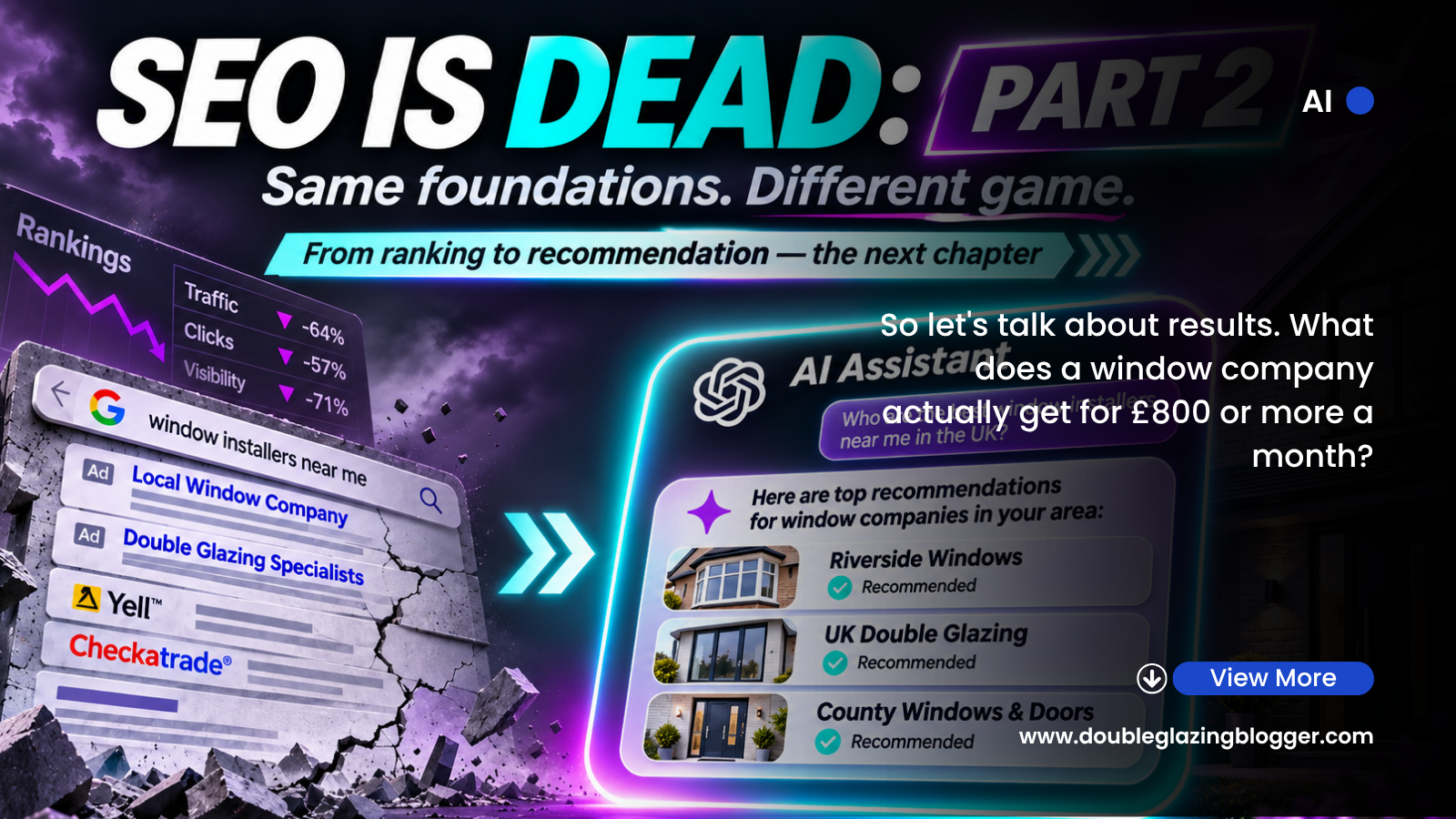
So let’s talk about results. What does a window company actually get for £800 or more a month?
The foundations being the same doesn’t mean the job is the same. And it definitely doesn’t mean the invoice should be.
Get listed. Get ranked. Get recommended.
Remember the Yellow Pages? You paid to get listed. Your business name, location, services, and reputation helped customers find you.
Then Google arrived. Same businesses. Same addresses. Same information. A completely different way of being discovered.
We didn’t call it Digital Directory Optimisation. We called it Search Engine Optimisation.
Now it’s happening again.
· Yellow Pages: Get listed.
· Google: Get ranked.
· AI: Get recommended.
And before someone argues that GEO retains most of the old name, so did email.
Postal mail became email. Same purpose. Same word at the end. Completely different delivery, speed, cost, and skills.
Nobody thinks a Royal Mail sorting office is an email provider.
Search Engine Optimisation has evolved into GEO, Generative Engine Optimisation. Same underlying principles. Different technology, different methods and a different outcome.
And GEO isn’t some buzzword invented by marketing agencies looking for another revenue stream. The term was formally introduced in a 2023 academic paper involving researchers at Princeton University.
The researchers recognised that generative AI was creating a new challenge: improving how information appears within AI-generated answers, rather than simply where webpages rank.
The map isn’t the satnav
Another argument is that AI still retrieves information from Google, Bing and other search systems, so it’s all SEO.
That confuses where information comes from with how it’s used.
Satnav still relies on maps. Nobody hands you a road atlas and calls it the same service.
Streaming still delivers films. Nobody calls Netflix a video rental shop.
AI can use traditional search engines to retrieve information. But you’re no longer simply optimising for a position in those results. You’re trying to influence which businesses an AI assistant finds credible enough to recommend.
And there’s evidence that the outcomes differ. In August 2025, Ahrefs analysed 15,000 prompts across major AI assistants.
On average, only 12% of the URLs cited by ChatGPT, Gemini and Copilot appeared in Google’s top ten results for the original question.
Ranking still helps. Nobody is suggesting otherwise.
But getting your website to number four on Google doesn’t guarantee you’ll appear in an AI recommendation.
The information may be the same. The decision about what to recommend is different.
Count the ads
Try something.
Search “double glazing [your town]” on Google. Count how far you get before you reach an actual local installer’s website.
I tried it for Enfield.
Four paid ads. A strip of directories. A map. A box Google labels as offers from advertisers. Then, finally, a local company’s website.
Then two more ads from national brands.
Seven paid placements on one page.
Your agency might get you onto page one organically. But look at what the homeowner has to navigate before reaching you.
You’re paying to climb a ladder while Google keeps moving the first rung further down the page.
That’s what you’re competing with. National brands with enormous advertising budgets, directories dominating the results and Google’s advertising machine.
Is it any surprise homeowners are increasingly asking ChatGPT instead?
One question. Three recommendations. No need to trawl through pages of sponsored results.
Yes, ChatGPT has begun introducing advertising on its Free and Go plans, not Plus or Pro. I expect advertising-funded free AI services to become increasingly common.
But the experience is fundamentally different. The customer is asking for an answer, not a page of competing advertisements.
“But ChatGPT sends hardly any traffic”
Of course it doesn’t. The AI answer doesn’t necessarily need a click.
A homeowner asks for three local window companies, gets recommendations and rings one.
Or they search for that company’s name afterwards and arrive through Google.
ChatGPT might never receive attribution for influencing that decision.
And when AI does send a website visitor, analytics don’t always correctly identify where they came from.
AI doesn’t need to send you a click to send you a customer.
So why are we still judging success primarily by website visits and rankings?
Want a better measure? Ask every customer how they found you. Include “ChatGPT or AI” as an option.
Monitor branded searches, direct enquiries, and how frequently AI recommends your business.
Your analytics report might tell you where a visitor arrived from. It won’t necessarily tell you who persuaded them to choose you.
What actually changes?
Let’s use a real-world example.
You’re a window installer in Lowestoft.
Your SEO agency proudly reports that you rank fourth for “double glazing Lowestoft”.
Now a homeowner asks ChatGPT:
“Recommend the best window company in Lowestoft. Compare their experience, customer reviews, accreditations and reputation.”
You might be recommended.
You might not appear at all.
There is no fixed position four in ChatGPT.
Ask the question again tomorrow, and the recommendations might change.
That doesn’t make it impossible to measure.
Test dozens of realistic customer questions across ChatGPT, Claude and Gemini, over multiple days. Record how often your company appears, which competitors get recommended, and what evidence supports those recommendations.
Then investigate what’s missing.
Is your competitor appearing in independent articles? Do they have stronger publicly verifiable customer reviews? Better case studies? Clearer accreditations? More detailed evidence of actual installations?
AI can draw on publicly accessible information far beyond your website, from directories and review platforms to trade bodies and independent articles.
A brand mention can matter without a backlink. Yes, unlinked citations have existed in local SEO for years.
What’s different is that the customer can now receive the recommendation without ever visiting your website.
That’s the outcome we’re optimising for.
The platforms have already decided
In October 2026, Microsoft expanded its AI Performance reporting.
Businesses can now investigate the questions where their websites are cited in AI-generated answers and identify opportunities where other websites are being referenced instead.
Think about that.
We’re no longer simply asking where a webpage ranks.
We’re investigating which information AI uses to construct its answers, where competitors appear, and where our businesses are missing.
The platforms are building tools to answer these questions because traditional ranking reports don’t provide the complete picture.
If your agency is still reporting nothing but Google rankings, you’re only seeing part of the customer journey.
“Good agencies already do all this”
Some absolutely do.
Great. Then show your clients the results.
This isn’t an opinion formed from watching a few YouTube videos about AI.
I’ve consulted within this industry. I’ve seen how marketing services are delivered, the workflows involved and the reports businesses receive.
I’ve seen the familiar formula.
A ranking report. A handful of generic articles. Another location page with the town name changed.
“Popular composite door colours.”
“How to maintain your uPVC windows.”
“The best replacement windows for your home.”
Sometimes hundreds or thousands of pounds every month.
AI can produce that material in seconds.
And so can everyone else’s agency.
Why would AI recommend your business if you’re publishing exactly the same information as everyone else?
The answer isn’t more content. It’s better content.
Real installations. Original photographs. Honest technical advice. Customer experiences. Opinions informed by years of working in the industry.
And AI can help you turn that knowledge into excellent marketing yourself.
The people challenging this argument know the industry. So do I.
Perhaps that’s why this discussion has become so uncomfortable.
“SEO has been declared dead every year since 1997”
It has.
Each time, the techniques evolved, the algorithms changed, and the click remained central to the business model.
This time, the click is becoming optional.
That’s not a minor algorithm update.
It’s a fundamental change in how customers discover and choose businesses.
When you’ve spent twenty years building a career around SEO, I appreciate that being told it’s dead might sound personal.
But business owners aren’t paying agencies to protect a profession.
They’re paying to win customers.
And if you can get a window company to number one on Google while AI consistently recommends three of its competitors, have you succeeded?
By traditional ranking metrics, yes.
By the measure the business owner actually cares about, perhaps not.
Yes, I’m selling something
I wasn’t.
The responses to my last article changed that.
If we’re going to debate whether AI can replace much of the SEO work agencies charge for, let’s actually demonstrate it.
At Aperture Works, we’re putting together a one-day workshop showing window companies how to use Claude, AI and connected tools to take greater control of their own marketing.
Not another presentation full of buzzwords and promises.
A practical day of learning, demonstrations and a look at where we believe the technology is heading.
We’ll explore and demonstrate how AI can:
· Audit your website, identify technical SEO issues and suggest or implement fixes through suitable connections.
· Research competitors, identify content opportunities and explain why they may be getting recommended instead of you.
· Investigate GEO, testing how ChatGPT, Claude, and Gemini respond to realistic customer questions.
· Create worthwhile content, turning your installations, experience and knowledge into articles and case studies in your own voice.
· Connect to your systems, demonstrating how MCP can allow Claude to interact with websites, marketing platforms and business data.
· Automate repetitive marketing work, showing how monitoring, reporting and approved website updates can become part of an ongoing workflow.
You’ll see real demonstrations, understand what’s possible today and get a glimpse of what we believe is coming next.
Most importantly, you’ll learn how to start applying these tools to your own business.
One day. £500 per person.
Held at Aperture Works HQ, with limited numbers so our team can spend time answering individual questions.
No ongoing fees to us. Some connected tools and services may have their own subscription costs.
Open to window companies, manufacturers and suppliers.
Sorry, agencies. Nothing personal.
Well, a little bit.
If you still want an agency, that’s absolutely fine. But at least you’ll understand what AI can do, what you’re paying for and what you could realistically manage yourself.
Places are first come, first served. Full details on application.
The principles were never the problem
Relevance. Reputation. Credibility. Proof. Being genuinely useful.
That was always the job.
The problem is paying every month for yesterday’s methods while your customers are discovering businesses in entirely new ways.
The Yellow Pages didn’t become irrelevant because addresses stopped mattering.
Blockbuster didn’t disappear because people stopped watching films.
And traditional SEO won’t lose its dominance because businesses stop needing to be found.
It will lose its dominance because the way people find, evaluate, and choose businesses has changed.
You can spend the next five years arguing that GEO is technically still SEO.
Or you can spend that time making sure AI recommends your business.
I know which I’d rather do.
The customer has moved on. The invoice didn’t.
If you’re interested in the course, please email [email protected]

Subscribe for FREE below to receive the weekly DGBulletin newsletter and monthly digital magazine!