
Welcome to the first in a new guest series focusing on tech and AI, kindly provided by Paul Edwards, founder of AI fenestration company Aperture Works:
Google just lost $500 billion in a single day. If you’re still paying someone to “do your SEO”, it’s time to ask some uncomfortable questions.
On 29 October, Google’s parent company Alphabet had the worst trading day in its history. Around $500 billion was wiped off its value in 24 hours.
The reasons were disappointing search advertising, huge AI spending, and a growing fear that AI is eating the thing Google was built on: people typing a question and clicking through to a website.
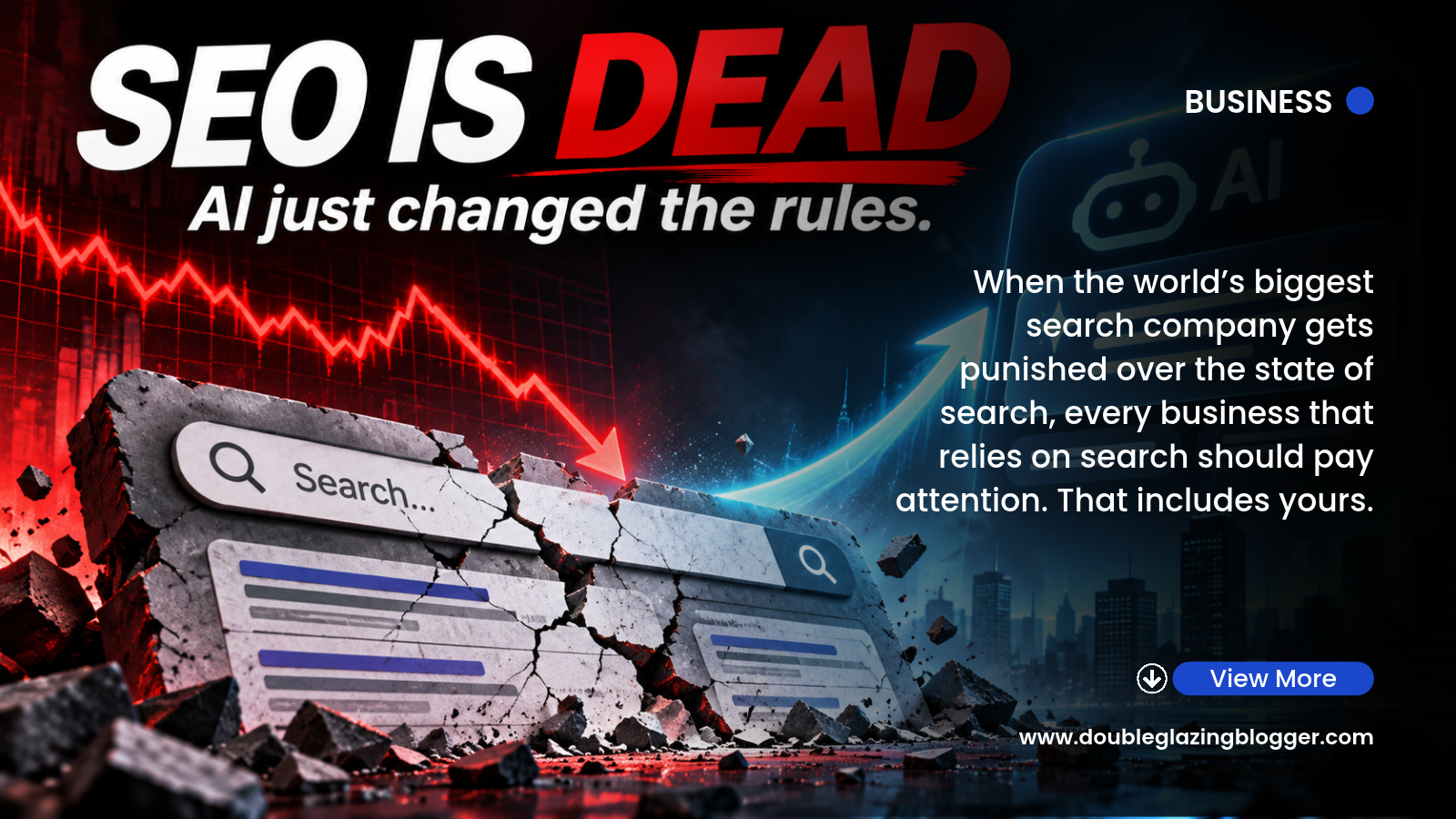
When the world’s biggest search company gets punished over the state of search, every business that relies on search should pay attention. That includes yours.
Your customers have already moved
In February, Ahrefs estimated that ChatGPT was already handling the equivalent of 12% of Google’s search volume. OpenAI’s own research, sampling a million ChatGPT messages a month from July 2024 to September 2026, found information-seeking rose from 16.7% to 20.2% of all messages. In the UK, it’s 22.7%. That’s people researching products, services, and who to buy from, not getting AI to write their emails.
Google still sends far more traffic to websites. But that’s no longer the point. The click is disappearing.
“uPVC or aluminium?” “How much is a conservatory roof replacement?” “Is triple glazing worth it?” Homeowners now get those answers straight from ChatGPT, or from Google’s own AI Overviews at the top of the page, without ever landing on your website.
Try it yourself. Open ChatGPT or Claude and ask: (Ask more than once. The answers vary, and that tells you something too)
“Recommend a window company in [your town]. For each recommendation, explain why you chose them, what makes them stand out, and what publicly available evidence supports your decision, including reviews, reputation, experience, and industry accreditations. Include your sources.”
Are you being recommended? If not, why not? Try a few different towns and compare the results. You might be surprised which companies AI recommends and what information influences those recommendations.
SEO is dead. Marketing isn’t.
SEO was about getting your website found by a search engine. The game has changed and so has the name. The new one is GEO, Generative Engine Optimisation: getting your business found, understood, referenced and recommended by ChatGPT, Claude and Google’s AI search.
The technical foundations haven’t disappeared. They’ve evolved. It’s no longer just about getting your website to the top of a search results page. It’s about giving AI a reason to recommend your business.
What hasn’t changed is what makes a business worth recommending. That was always the real job. SEO just let a lot of people get paid for skipping it.
The SEO gravy train has run out of track
For years, window and door companies have paid agencies hundreds, sometimes thousands, of pounds a month for “SEO content”.
“Popular composite door colours for 2026.” “How to maintain your uPVC windows.” The Christmas front door article, reheated for the twelfth year running. And the classic: the same page copied for every town you want to rank in, with “Wakefield” swapped for “Pontefract”.
That approach worked because you could game a search engine with 200 near-identical pages. But why would an AI recommend yours when it can find something genuinely better?
AI can also write every one of those articles in seconds. Your agency knows that. Plenty of them are already doing it.
So what exactly is the invoice for?
The new rules are the old rules
You don’t win at GEO by flooding your website with AI-generated content. If 200 window companies publish the same guide to A-rated windows, AI has no reason to pick yours. It recommends the source that has something the others don’t. In our industry, that means:
· Real installations with your own photos, not stock images of a house you’ve never been near
· Honest answers to awkward questions: when triple glazing isn’t worth it, and why the cheapest quote rarely is
· Reviews and case studies that can be verified
· Technical knowledge from people who’ve actually fitted the product
· Opinions. AI is trained to sit on the fence. You don’t have to.
Look at that list. None of it is new. It’s what good marketing has always been: show what you’ve done, prove it, and be useful. The only difference is that you can’t fake it anymore.
So do you still need an agency?
Maybe not.
If you’re willing to spend a little time working with AI yourself, you can produce marketing that’s genuinely personal and reflects your business, your installs and your customers. Nobody knows your business better than you.
If you don’t have the time, or simply don’t want to spend it on marketing, find an agency that works with you. One that asks questions, understands your customers, and turns your knowledge into something worth reading. Not one that feeds a few keywords into ChatGPT and sends an invoice.
Quality over quantity. That’s the whole game now.
This is only the beginning
AI hasn’t killed good marketing. It’s exposed how much bad marketing people were paying for.
Right now, the question is whether AI recommends you. Soon it will be whether your AI knows your business well enough to market it for you: your jobs, your products, your customers, your voice. The companies that start capturing that knowledge now will be miles ahead of the ones still paying for keyword-stuffed blogs.
SEO is dead. Good marketing just got a new name, and new rules for who wins.

Subscribe for FREE below to receive the weekly DGBulletin newsletter and monthly digital magazine!