
Geopolitical instability is feeding cost pressure into the window and door supply chain, as rising energy prices, transport disruption and raw material volatility create fresh challenges for manufacturers, fabricators and installers. We report.
The CPA Spring 2026 Forecast predicts total construction output is forecast to fall by 2.5% this year, with private housing output down 7.0%.
At the same time, the home improvement market is also under pressure, with private housing repair, maintenance and improvement forecast to fall by 8.0% this year as homeowners remain cautious about discretionary spend.
The CPA highlights UK GDP growth of just 0.5% in 2026, CPI inflation averaging 3.5%, real household disposable income falling 2.0%, and Bank of England base rates rising to 4.25% by the end of the year.
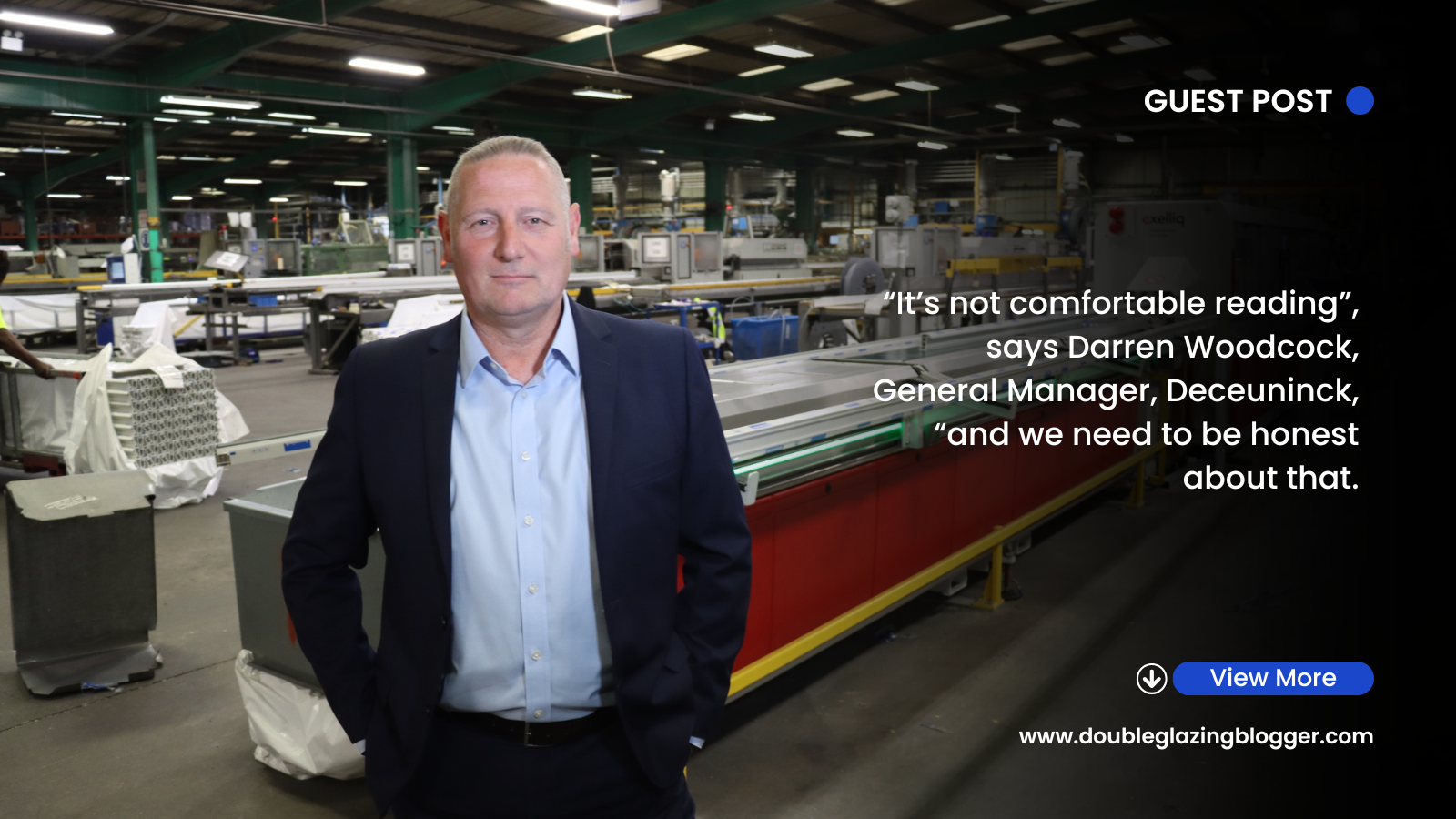
“It’s not comfortable reading”, says Darren Woodcock, General Manager, Deceuninck, “and we need to be honest about that.
“It’s increasing costs for every single manufacturer in the UK, while impacting consumer confidence with a knock-on effect on the housing market, new build and home improvement.
“It requires a dose of realism – and we’re adjusting for it. Controlling costs where we can, supporting our customers in doing the same and helping them to convert and maximise margin on each and every opportunity that comes their way.
“It’s important to remember that even in a slower market, there is an opportunity to grow market share if you approach things in the right way.”
Consumer confidence is low. GfK’s Consumer Confidence Index fell four points to -25 in April, while expectations for the wider economy over the next 12 months dropped to -43, the lowest level since February 2023. Fuel costs, the prospect of higher energy bills and wider global instability are clearly feeding into household caution.
“On the one hand, costs are rising. On the other hand, consumers are becoming more price sensitive. Our customers need more flexibility from us because their customers need it from them”, Darren adds.
Single-length foils – free up cash!
He points to flexibility in Deceuninck’s colour offer. This includes its ability to supply foiled profiles in single lengths with no minimum order requirement.
“It gives fabricators far greater flexibility than a conventional model, particularly when they need to match a specific colour on a one-off job, complete a remedial order, or fulfil a lower-volume heritage job without committing cash to unnecessary stock”, he says.
“It improves cashflow, reduces risk on slower-moving colours and makes it easier to say yes to more specialist enquiries”, Darren continues.
“It also supports a higher-value sales strategy, because our customers can offer a broader and more design-led foiled range without carrying the commercial burden of stocking every finish in volume.”
A commitment to ‘play fair’
Darren points out that it’s not the first time in recent history that the industry has faced a challenge, highlighting disruption to the supply chain during COVID.
Now as then, Deceuninck has opted to move forward with a surcharge rather than a price increase. “We went with a surcharge in March. Not a price increase”, he explains. “That’s an important differentiation.
“A price increase is permanent. A surcharge is a temporary measure, designed to help us manage exceptional input-cost shocks and protect the long-term stability and sustainability of our business and our customers’ businesses.
“We appreciate it doesn’t make it a necessarily less bitter pill to swallow. We don’t like increases. Our customers don’t like increases, but it is fair. We won’t profiteer from this.
“The future is clearly difficult to call, but as evidenced during COVID, we moved forward with fairness, and we’ll do that again now.
“We need the surcharge to ensure that our business model is sustainable in the face of rising costs. Every systems company in the UK, in Europe, globally, is facing exactly the same pressures.
“Anyone who is saying anything else is simply not recognising the reality of raw material and energy increases.”
Transparency backed by investment
Deceuninck’s ability to limit the scale of the surcharge is supported by long-term strategic investment in its UK operation. That includes the installation of 2,500 solar panels at its manufacturing facility in Calne, generating 895,762 kWh of clean energy per year and reducing CO2 emissions by 498,507kg annually.
A further six-figure investment at the start of this year also saw Deceuninck add two new chillers to its operation, delivering a 50% reduction in energy usage.
Continuing opportunity
Darren points out that while higher energy prices tend to make consumers more cautious overall, they also make the energy efficiency message more relevant.
“People remember how quickly energy costs increased in recent years”, he says. “When prices begin to move again, it tends to focus minds on the long-term efficiency of their homes.”
Deceuninck is supporting home improvement specialists in delivering this message through practical sales tools, including its Energy Calculator, which demonstrates how replacing older windows can reduce household energy consumption and heating costs.
“We all need to be measured. When things are less certain (in fact, it feels a long time since anything has been certain), homeowners may be tempted to delay major purchases, take longer to decide and scrutinise value more closely”, Darren says.
“That doesn’t, however, mean the market disappears. It means the case for investment has to be clearer, more tangible and better evidenced.
“We’ll continue to support our customers in doing that and giving them the confidence to move forward through transparent and honest pricing.”
For more information, call 01249 816 969, email [email protected] or visit www.deceuninck.co.uk

Subscribe for FREE below to receive the weekly DGBulletin newsletter and monthly digital magazine!



“Price increases” v. “Surcharges”
Those of us who have been engaged in business for some time know this is just a play on words. WE haven’t noticed surcharges being removed and quite often the surcharges turn into price increases.
Yes, let’s be honest. If you need to increase your pricing say so, and give a reasonable excuse. That is fair.
Playing with words isn’t fair; it leads to mistrust.
One the principle reasons consumer confidence is falling is lack of trust. Scams, untrustworthy politicians and business people etc.