

Higher gas, electricity and diesel costs are exposing every stage of the window and door supply chain. If the pressure persists, the next six to twelve months could bring further price increases, tighter margins and greater demands on working capital.
The UK fenestration sector faces an energy shock that reaches well beyond manufacturers’ utility bills. Energy is used to produce its raw materials, turn them into profiles and glass, manufacture finished products and deliver them to site. At the same time, higher household energy spending threatens to reduce the money available for replacement windows, doors and larger home improvements.
The result is a difficult combination: rising costs to supply a product, alongside greater resistance to paying for it.
There is already evidence of higher input costs being passed through within the sector. However, the eventual scale of the impact will depend on individual energy contracts, purchasing arrangements, production efficiency and demand. No reliable sector-wide percentage increase in window and door prices can be calculated from movements in oil or gas alone.
Energy prices have risen sharply, but the markets are moving differently
The Bank of England’s September minutes recorded Brent crude at $106 a barrel and UK wholesale gas at 207 pence per therm at the close on 14 September. Those prices were respectively 36% and 78% higher than in the period leading up to its July report. These are dated wholesale benchmarks, not percentage increases in manufacturers’ delivered energy bills. Bank of England, September 2026 minutes.
Electricity has also repriced. Smarter Business’s market report recorded the Winter 2026 UK baseload power contract at £149/MWh at the opening on 7 September, up from £136.43/MWh on 1 September: an increase of 9.21%. Its day-ahead electricity price fell between those dates, illustrating why a short-term easing does not necessarily reduce the cost of securing power for winter. The report is an earlier September snapshot, not a live quotation. Smarter Business market report.
Crude oil and diesel are also diverging. Reuters reported Brent at $100.40 a barrel at 11:43 GMT on 23 September, while the premium of European low-sulphur gasoil futures over Brent reached approximately $95 a barrel amid concerns about potential US diesel export restrictions. That spread measures the difference between two wholesale benchmarks; it is not a UK pump price or a refinery’s net profit. Reuters, via Kitco.
For fenestration businesses, this distinction matters. A fall in the crude price does not guarantee an equivalent reduction in the price of diesel used by delivery vehicles and installation teams.
Why expensive gas also affects electricity users
Gas-fired generation remains an important influence on the wholesale electricity price in Great Britain. When gas generation is needed to meet demand and sets the marginal price, more expensive gas can increase power prices for businesses whose own equipment is electrically driven.
The government acknowledged this exposure in April when it announced plans to offer fixed-price contracts to eligible existing low-carbon generators. That announcement does not mean the gas-electricity link has already disappeared. Department for Energy Security and Net Zero.
Business bills also include network and other charges. They are not interchangeable with wholesale prices, and the domestic price cap does not cover non-domestic energy contracts. Ofgem says fixed contracts can delay the transmission of wholesale increases until renewal, while some regulated charges may still change under the contract terms. Ofgem’s explanation for non-domestic customers.
Consequently, two competing factories can experience the same market shock at different times. One may face higher costs immediately; another may encounter them when an existing agreement expires. That difference can temporarily influence pricing, competitiveness and margins.
Glass manufacturers: exposure at the start of the chain
Primary flat-glass production is one of the most energy-intensive stages relevant to fenestration. Pilkington describes raw materials entering molten glass at approximately 1,500°C, followed by a continuous sequence of refining, forming and controlled cooling. Pilkington’s float-process explanation.
For producers operating gas-fired furnaces, higher gas prices therefore affect a core production requirement. Electricity, raw-material processing and distribution add further exposure. A continuous melting operation has less flexibility to avoid an expensive trading period than equipment that can readily be scheduled into a different shift.
The commercial consequences could include revised base prices or energy surcharges, depending on contracts and competition. Those measures would carry the shock into glass processors and sealed-unit manufacturers, even where downstream businesses have protected their own electricity prices.
Persistent high costs also raise a capacity question. If production becomes less attractive while demand weakens, investment, furnace rebuilds and the economics of individual sites can come under pressure. This is a conditional risk, not evidence that particular plants will close because of the current shock.
Here, “glass systems companies” covers primary glass producers and suppliers of coated or processed architectural glass. Businesses within that description have different production footprints and cannot be assigned one uniform exposure.
Sealed-unit manufacturers: bought-in glass plus processing costs
Insulating glass unit manufacturers face the cost embedded in purchased glass and the cost of their own operations. Cutting, washing, handling and assembly all add to the production bill. Businesses with in-house toughening have an additional substantial electricity requirement; those buying toughened glass encounter it through supplier prices.
Equipment manufacturer Glaston identifies the furnace and quench as the main energy users in tempering. It also highlights loading efficiency and recommends measuring consumption per square metre of processed glass. Glaston’s technical explanation.
This creates a further vulnerability if order volumes fall. Poorer utilisation can increase energy and overhead costs per saleable unit, even when a factory’s total consumption declines. The effect depends on the machinery, product mix and production schedule.
Sealed-unit makers must also buy spacers, sealants, desiccants and gas fills, and transport a heavy, fragile product. These inputs should be monitored individually; an increase in oil does not prove that every sealant or spacer price has risen by the same amount.
Triple glazing involves an additional pane and associated processing and weight compared with an equivalent double-glazed unit. That gives it different cost exposure, but does not justify assuming the complete unit or installed window will rise by 50%.
In a sustained shock, remakes and breakages become more expensive because replacement production consumes materials, energy, labour and delivery capacity again.
PVCu systems companies: feedstock and factory exposure
PVCu has several routes of exposure. The European Council of Vinyl Manufacturers explains that PVC resin is made from chlorine and ethylene, with ethylene principally derived from oil or gas. Chlorine production involves electrolysis, while subsequent stages involve chemical processing before compounding and extrusion. ECVM’s production guide.
The inference for window systems companies is that energy costs can arrive both through purchased resin and through profile production. Electricity is required to operate extrusion and associated plant; additives, packaging and transport bring further supplier exposure.
Nevertheless, PVC resin is not simply crude oil in another form. Its selling price also reflects supply, demand, plant availability, imports and commercial negotiations. Weak demand can restrain resin prices even while producers’ energy costs rise.
Recycled material can reduce reliance on virgin feedstock, but collection and reprocessing still have costs. Its protective value depends on availability, quality, processing efficiency and the relative price of virgin resin.
Eurocell’s half-year report provides a current example of cost pressures reaching the sector. The company said it was mitigating higher input costs through surcharges and sales strategies. Its Profiles division reported third-party revenue and volumes each down 5%, with adjusted operating profit down 24% to £6.3 million. Eurocell attributed the profit decline to lower volumes plus labour and other cost inflation; it should not be presented as an energy-only decline. Eurocell H1 2026 report.
The broader implication is that recovering higher production costs becomes harder when customers are already buying less.
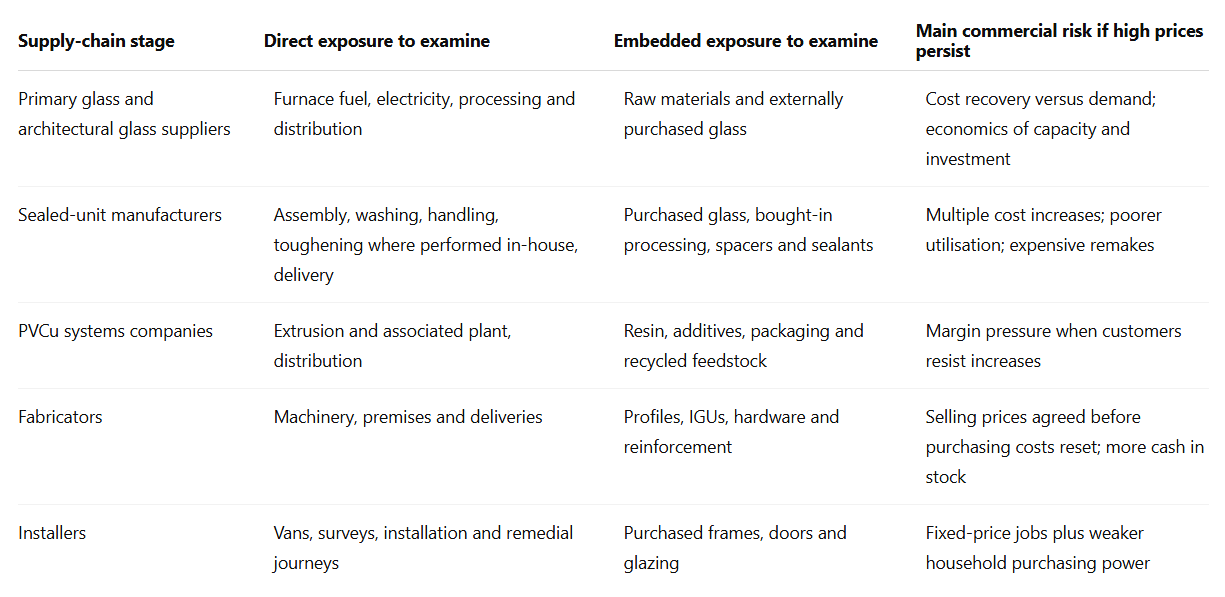
Supply chain exposure map
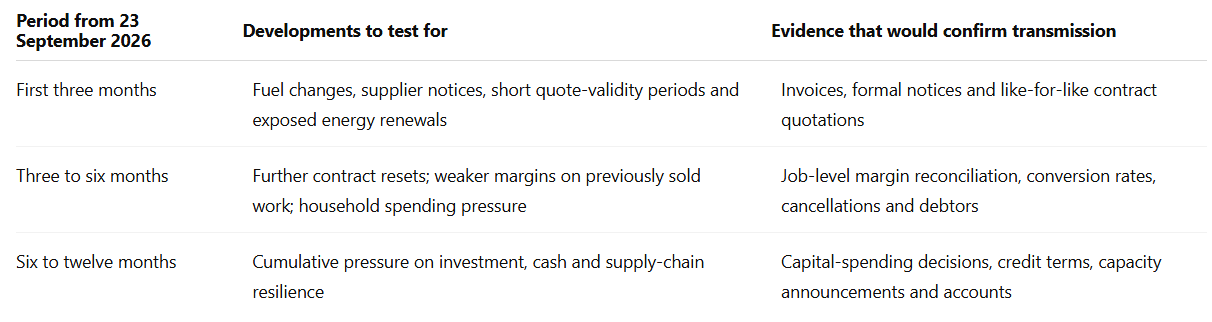
Conditional timeline if elevated costs persist
Fabricators: multiple supplier increases can arrive together
Window and door fabricators sit at the junction of these upstream pressures. They buy profiles, sealed units or glass, hardware, reinforcement, gaskets and other components, while paying for their own manufacturing and deliveries.
Their largest energy-related exposure may therefore sit inside supplier invoices rather than on their own utility bill.
A fabricator with a favourable electricity contract can still face higher profile prices, glass surcharges and delivery charges. Conversely, a fabricator might avoid immediate supplier increases but face a sharply higher energy renewal. Looking only at electricity expenditure would miss either situation.
Timing is critical. Orders priced before a supplier increase may remain in production afterwards. If their selling price is fixed, the additional cost reduces the margin on that order unless purchasing terms provide protection.
Higher material values can also increase the cash tied up in stock and work in progress. If customers take longer to pay, the business may need more working capital even without any increase in the number of windows manufactured.
Aluminium products have a related upstream exposure. Hydro identifies primary aluminium production as electricity-intensive, while recycling uses a fraction of that energy. This does not mean recycled profiles are insulated from metal prices, extrusion costs or freight. Hydro’s aluminium life-cycle guide.
Installers: the final price increase meets the customer
For installation businesses, the main channels are likely to be purchased products, vehicle fuel and demand. An installer may use relatively little energy directly compared with a manufacturer, yet receive the accumulated cost increases embedded in finished windows and doors.
Survey visits, installations, remedial work and collections all require travel. Higher fuel costs are particularly difficult to recover on dispersed jobs or repeat visits where the selling price has already been agreed.
The greater challenge may be the household budget. Ofgem has confirmed a 4% increase for a typical dual-fuel household paying by Direct Debit under the October–December 2026 cap. Its published average gas unit rate is 7.97p/kWh. The cap applies in Great Britain and limits rates and standing charges, not a household’s total expenditure. Ofgem’s October–December announcement.
For the replacement market, the analytical risk is slower purchasing decisions, smaller orders and greater price comparison as essential spending takes priority. Developers can also face pressure if higher build costs coincide with constrained buyers’ budgets.
Higher energy prices strengthen the cash value of reducing heat loss, all else equal. But the ability to finance an upgrade can deteriorate at the same time. A stronger energy-efficiency case does not automatically produce more orders.
The savings from any particular installation depend on the existing windows, the property, heating system and occupancy. A rise in energy prices alone is not a basis for promising that replacement glazing will quickly pay for itself.
A US diesel export ban would add a separate supply shock
The possibility of US export restrictions is a material additional risk. Reuters reported on 23 September that President Donald Trump had backed the idea of a diesel export ban, with European diesel markets reacting. The reporting reviewed for this article describes a potential restriction, not an implemented blanket ban. Reuters, via Kitco.
The American Petroleum Institute said on 22 September that restricting exports could force US refiners to reduce throughput because surplus diesel could not simply be redirected throughout the domestic market. API represents the US oil and gas industry, so this is an industry assessment rather than an independent forecast. API statement.
For UK fenestration, the likely transmission would be through the international diesel market. Buyers seeking replacement cargoes would compete for alternative supplies. The UK could face higher costs even where a particular shipment did not originate in the US.
Raw materials, profiles, glass, completed frames and installation teams all travel. A fuel shock could therefore affect several separate journeys before an installation is complete. Hauliers might recover costs through revised rates or fuel surcharges, depending on their agreements.
A full ban, a partial restriction and temporary limits would have different effects. Duration, exemptions, inventories and alternative refinery output would matter. There is no sound basis here for predicting a specific UK pump-price increase or claiming inevitable shortages.
What the next six to twelve months could look like
The following outlook is scenario analysis for the period to March–September 2027, rather than a numerical forecast of industry selling prices.
If energy remains expensive without another major disruption, the principal risk is progressive cost transmission. Businesses approaching renewal would face the prevailing contract market. Suppliers whose earlier protection expires could seek further recovery through pricing. Fixed-price order books would leave some fabricators and installers absorbing increases before new quotations catch up.
Over several quarters, sustained pressure could mean weaker margins, tighter credit terms and delayed investment. Lower volumes would make it harder to spread overheads. Financially weaker suppliers could become more vulnerable, although energy costs alone cannot establish whether any individual business will fail.
If there is a further shock, such as substantial US diesel export restrictions, prolonged LNG disruption or a combination of cold weather and low renewable output, the pressure could intensify. Depending on the event, transport, heating and electricity costs could rise together. Delivery schedules and manufacturing continuity would become more important if actual supply constraints emerged. High prices by themselves do not establish physical rationing.
If geopolitical conditions improve and energy prices fall, relief would still be uneven. Businesses buying at market-linked prices could benefit sooner than those committed to higher fixed rates. Previously purchased materials and supplier contract terms could delay reductions in finished-product prices. Confidence and order volumes might take longer to recover than commodity markets.
The Bank of England held Bank Rate at 3.75% in September, with three members favouring an increase. It expected inflation to rise slightly above 4% in early 2027 on the energy assumptions then available. This adds a financing risk: firms and households cannot assume that cheaper borrowing will offset higher operating and living costs. Bank of England, September 2026 minutes.
The cost of a window cannot be forecast from the oil price alone
The commercial effect depends on the share of a business’s costs that actually changes.
As a simple illustration, if energy represents 10% of an operation’s total cost base and its effective energy price rises 50%, the direct increase in total costs would be 5%, assuming unchanged consumption and everything else remaining equal. Supplier increases, freight and lower production volumes would need to be assessed separately.
Similarly, if fuel represents 25% of a delivery operation’s cost and fuel prices rise 20%, the direct arithmetic adds 5% to that operation’s costs. It does not add 20% to the price of the finished window. These are illustrative assumptions, not measured industry averages.
Care is also needed to avoid counting the same increase twice. Where a purchased unit already includes the glass supplier’s energy surcharge, that embedded cost should not be added again as a separate downstream exposure.
For the coming year, the most useful indicators will be actual energy renewal quotations, supplier price notices, delivered diesel costs, production utilisation and the margin remaining on committed work. Order conversion, payment times and cash requirements will show whether businesses can recover those costs.
The highest risk to UK fenestration is a prolonged period in which products become more expensive to manufacture and deliver while customers become less able to buy them. The extent of that squeeze will depend as much on contracts, efficiency and financial resilience as on the next movement in the energy markets.

Subscribe for FREE below to receive the weekly DGBulletin newsletter and monthly digital magazine!